
France Clinches the 2026 Six Nations Title in a Last-Minute Thriller Against England
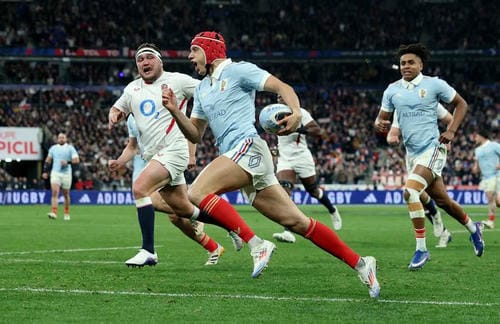
The 2026 Six Nations Championship delivered one of the most dramatic finishes in the tournament’s long and storied history. Across five rounds of fierce competition, Europe’s premier rugby nations battled through a tournament filled with record-breaking scores, historic upsets, and emotional moments for teams seeking redemption. Yet in the end, everything came down to the final kick of the final match. On March 14, France secured the title in unforgettable fashion, defeating England 48–46 after fullback Thomas Ramos calmly slotted a last-minute penalty with the clock already in the red.
The championship itself ran from early February through mid-March and featured the six traditional participants: England, France, Ireland, Italy, Scotland, and Wales. The competition represented the 132nd season of the tournament in its various historical forms and the 27th since it became the Six Nations Championship in 2000.
Even before the final day arrived, the 2026 tournament had built a reputation for chaos and unpredictability. High-scoring matches became a defining feature, with attacking rugby dominating many fixtures. Teams that entered the competition with modest expectations produced surprise performances, while traditional powers alternated between brilliance and inconsistency. By the final weekend, several nations still had mathematical hopes of lifting the trophy, creating the kind of tension rarely seen in the modern era of the championship.
Ireland appeared poised to steal the title earlier in the day after defeating Scotland and temporarily moving to the top of the standings. But their celebration proved premature. The championship would instead be decided later that evening in Paris, where France and England produced an extraordinary contest that epitomized the unpredictable spirit of the entire tournament.
When the final whistle eventually sounded at the Stade de France, the scoreboard told the story of a remarkable spectacle. Thirteen tries had been scored, momentum had shifted repeatedly, and the outcome had remained uncertain until the final moments. France’s victory ensured they retained the Six Nations crown and completed back-to-back championships for the first time in nearly two decades.
But the dramatic finale was only one chapter in a tournament that delivered remarkable narratives across all six participating nations.
The Paris Thriller That Crowned France
Few rugby matches manage to capture the full emotional range of sport—excitement, tension, frustration, and triumph—within eighty minutes. The 2026 clash between France and England achieved exactly that.
The historic rivalry between the two nations, often referred to as “Le Crunch,” has produced many memorable encounters over the decades. Yet even by those high standards, this match stood out as one of the most extraordinary in the fixture’s history.
England arrived in Paris under heavy scrutiny after a difficult championship campaign. Their earlier defeats had effectively removed them from title contention, leaving pride and momentum as their primary motivations in the final round. Despite their struggles, the team delivered a fearless attacking performance, scoring seven tries and pushing the defending champions to their absolute limit.
France, meanwhile, carried the pressure of expectation. As the reigning champions and one of the most talented squads in international rugby, they entered the match knowing that victory would secure another title. Yet the match quickly turned into a rollercoaster of momentum swings, with both teams exploiting defensive weaknesses to produce a relentless scoring exchange.
Among the standout performers was French winger Louis Bielle-Biarrey, who crossed the try line four times during the match. His explosive speed and positional awareness repeatedly exposed gaps in England’s defensive structure. Over the course of the tournament he accumulated nine tries, an impressive tally that underscored his growing reputation as one of Europe’s most dangerous attacking players.

England refused to fade despite the French onslaught. With only minutes remaining, winger Tommy Freeman scored a try that pushed England ahead 46–45, seemingly setting the stage for one of the greatest upsets in recent Six Nations history. For a brief moment, Ireland appeared ready to celebrate an unexpected championship victory from afar.
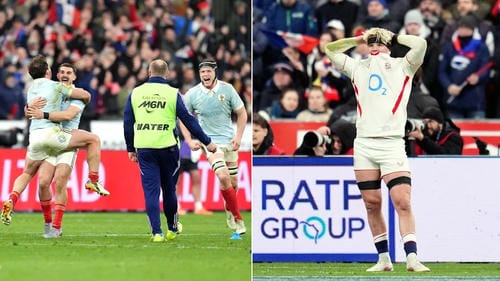
But rugby often rewards composure under pressure. In the dying seconds of the match, France forced a penalty opportunity deep in England territory. Captain Antoine Dupont consulted with the referee about the precise location of the infringement before Thomas Ramos stepped forward to take responsibility for the decisive kick.
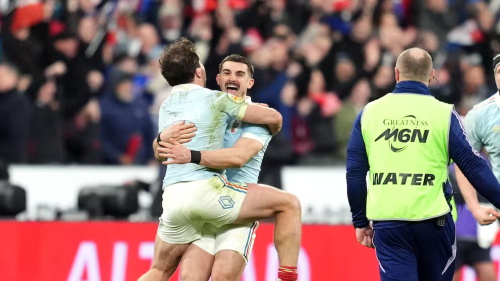
Ramos had already delivered an exceptional performance throughout the evening. As the tournament’s leading point scorer, he had built a reputation for reliability from the kicking tee. When he lined up the long-range attempt from more than forty meters, the stadium fell silent. Moments later the ball sailed cleanly between the posts, igniting celebrations across the French squad and confirming their championship triumph.
The final score—48–46—represented the highest-scoring match ever played between England and France. It also encapsulated the attacking spirit that defined the entire 2026 tournament.
For England, the defeat was heartbreaking but not without positives. Despite finishing near the bottom of the standings, their performance in Paris demonstrated resilience and attacking potential that could shape future campaigns. Many analysts suggested that the narrow loss might ultimately serve as a turning point for a rebuilding English side.
France, however, were the undisputed champions of the moment. Their ability to perform under immense pressure reinforced their status as one of the dominant forces in European rugby.
Upsets, Records, and Turning Points Across the Tournament
While the dramatic Paris finale captured global attention, the broader story of the 2026 Six Nations extended far beyond a single match. Throughout the tournament, nearly every participating nation produced moments that reshaped expectations and altered the competitive landscape of European rugby.
One of the most historic results came in Rome, where Italy achieved something previously thought improbable. For the first time in history, the Italian national team defeated England in a Six Nations match, securing a 23–18 victory at the Stadio Olimpico. The result ended decades of English dominance in the rivalry and represented a major milestone for Italian rugby.
Italy’s breakthrough carried symbolic significance for the tournament as a whole. Since joining the championship in 2000, the Italian side has often struggled to compete consistently with the traditional powers. Victories have been rare, and the team has frequently finished at the bottom of the standings. Yet their triumph over England suggested that the competitive gap between nations may be narrowing.
Another unforgettable moment arrived when Scotland produced one of the highest-scoring victories in the tournament’s history. In a remarkable display of attacking rugby, the Scottish team defeated France 50–40, handing the eventual champions their most painful loss of the campaign. The match illustrated Scotland’s offensive potential while also highlighting the defensive vulnerabilities that plagued France throughout the competition.
The result served as a reminder that even the tournament’s strongest teams could not afford complacency. Although France ultimately lifted the trophy, their journey included moments of vulnerability that opponents exploited with devastating efficiency.

Elsewhere, Wales experienced an emotional breakthrough that resonated deeply with supporters. After enduring a difficult period marked by a 15-match losing streak in the championship, the Welsh side finally returned to the winners’ column with a 31–17 victory over Italy in Cardiff. The triumph provided relief for players and fans alike, symbolizing a potential turning point after several challenging seasons.
For Wales, the victory represented more than just two points in the standings. It restored a sense of belief within a rugby nation that had struggled to maintain its traditional competitiveness in recent years.
Taken together, these moments illustrated why the 2026 Six Nations will likely be remembered as one of the most entertaining editions in modern history. From historic first victories to record-breaking scorelines, the tournament delivered a constant stream of storylines that captivated supporters across Europe and beyond.
The championship ultimately reinforced the unpredictable nature of international rugby. Traditional hierarchies remain influential, but the margins between teams continue to shrink as tactical sophistication and player development improve across the continent.
As France celebrated another title and rivals reflected on missed opportunities, one thing became clear: the 2026 Six Nations had raised the bar for drama, intensity, and spectacle in European rugby.
About the Author:
Ryan Halstead is a veteran rugby journalist and former regional club analyst who has spent more than fifteen years covering international rugby competitions across Europe. He began his career as a match analyst for semi-professional clubs in northern England before transitioning into sports media, where he now writes feature stories and tactical breakdowns focused on elite rugby union. Halstead has contributed to several independent rugby publications and has reported on multiple Six Nations Championships and Rugby World Cup tournaments. Known for blending historical context with detailed match analysis, his writing explores how tactical trends, player development, and national rugby cultures shape the modern game.
References:
[1] ABC News. (2026, March 15). France wins back-to-back Six Nations championships after dramatic last-second penalty.
[2] Sky Sports. (2026). Six Nations 2026 review and match reports.
[3] Pretot, J. (2026, March 14). Ramos last-gasp kick earns France Six Nations title with 48-46 win over England. Reuters.
[4] Kitson, R. (2026, March 14). France win Six Nations with last kick as Thomas Ramos sinks England in thriller. The Guardian.
[5] The Guardian Sport. (2026, March 16). Six Nations 2026: our writers pick their tournament highlights. The Guardian.
[6] Reuters. (2026, March 15). England coach Borthwick sees blueprint despite France defeat. Reuters.
[7] The Guardian. (2026, March 15). Borthwick rues agony after England’s narrow defeat to France. The Guardian.
Recommend for you:

Why Automated Ball-Strike Technology Is Becoming the Most Debated Issue in International Baseball?
Baseball is often called the thinking man’s game, a sport that prizes nuance, strategy, and tradition.
Virtual Obstacle Courses Are Redefining Modern Competitive Sports
In recent years, the world of competitive sports has been expanding beyond traditional arenas, welcoming innovative formats that blend physical skill with digital ingenuity.
March Madness Signals Another Chapter in College Basketball’s Enduring Power Structure
Each March, the announcement of the NCAA Division I Men’s Basketball Tournament bracket transforms the college basketball landscape overnight.
A Winter Games Defined by Records and Nordic Supremacy
The 2026 Winter Olympics, staged across Milan and Cortina d’Ampezzo in Italy from February 6 to February 22, delivered the type of drama and spectacle that defines the Olympic tradition.